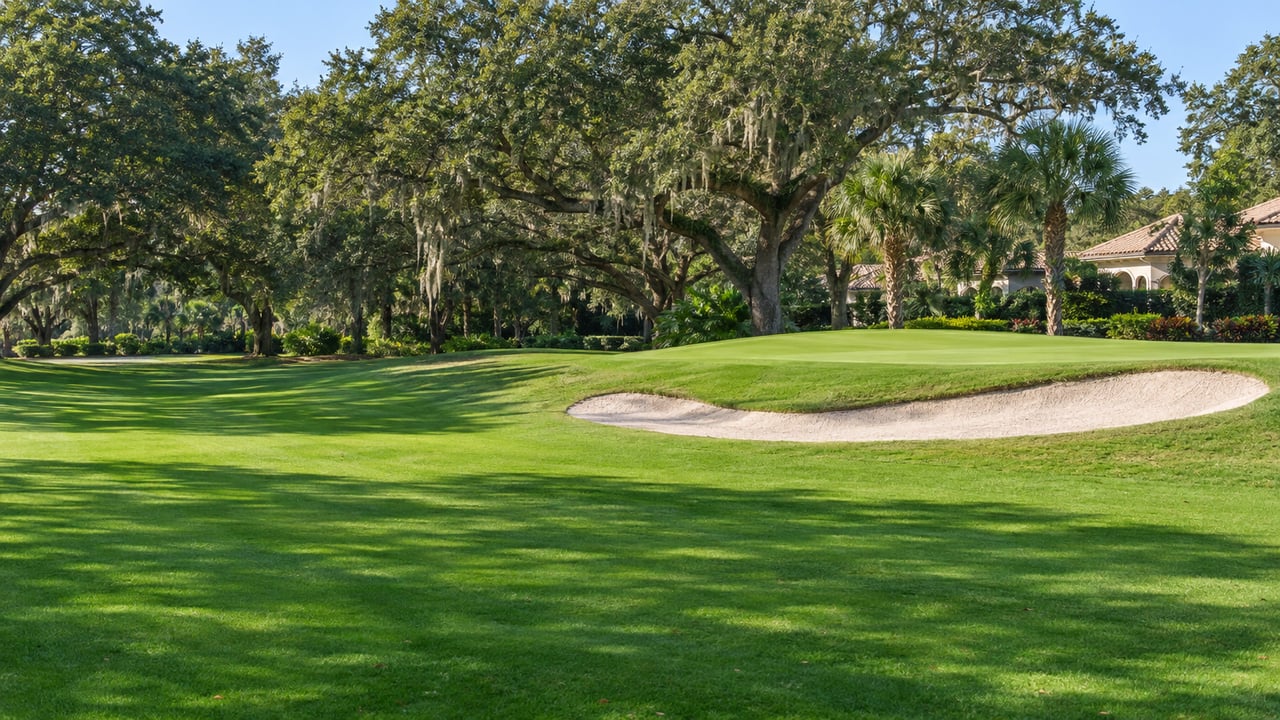
At a Westchase Community Development District workshop on February 17, golf course consultant Greg Christovich joined by video and gave the board numbers it had not heard in years. The Westchase Golf Course has been privately owned since it was built in 1992. The Sano Corporation has owned it since 2005. By Christovich's estimate, the course now brings in about $3.5 million a year on 47,000 rounds, double the rounds it saw in 2018, and it had estimated 2025 earnings of about $1.1 million, according to WOW's report on the workshop.
Those figures came from conversations with the course's general manager and owner. The board has not seen the books, and Supervisor Reggie Gillis said so at the same meeting. Even so, they point to one thing anyone comparing Westchase should understand about the roughly 200 acres in its middle. The course recovered, and that recovery made it harder for the community to buy. A busy, profitable course costs more, and it draws other buyers too.
In 2018 the board passed
This is the CDD's second look at the course. Christovich first worked for the board in 2018 and did a full due-diligence assessment. At that time the course was losing money and had about $1.3 million in deferred maintenance. The asking price was $2 million over the course's valuation, and the board decided not to proceed.
In 2018 the course's value was low because the business was weak, and the price was still too high. In 2026 the business is strong, and the market around it has changed too. Christovich described a "feeding frenzy" of private equity and institutional buyers acquiring golf courses, something he said the industry had not seen in 35 years. He said courses are selling at very high prices and that sellers base their value on recent transactions such as Cheval and Lakewood Ranch.
The course's improvements have not kept pace with its revenue. Christovich told the board that capital needs are probably much higher than in 2018 because the course has had no major capital improvements. At an outreach session before the October CDD workshop, Gillis showed photos he said pointed to a need for extensive improvements. Any buyer in 2026 would be paying for a profitable business and also taking on the cost of catching up on its upkeep.
Two numbers are in circulation
At that October session, Gillis told residents the owner is shopping the course. He also said there had been mention in recent months of an unofficial offer for the CDD to buy an easement or development restriction for $3.5 million. That was followed by a nonbinding offer to sell the course itself for $6.5 million in five years. WOW reported that no official offer or action has been made.
The two figures describe different purchases: $3.5 million for limits on what could be built, and $6.5 million, paid five years out, for the course itself. Either way, the community would be negotiating against a market Christovich described as full of eager buyers, while working from numbers it has not been able to verify.
So far the board has taken one formal step. It signed an engagement letter with Christovich so he can estimate the course's current worth and the cost of renovations and run a cost/benefit analysis. Gillis called it strictly due diligence. The October 6 CDD agenda listed ratification of a consulting agreement concerning the golf course. Former supervisor Greg Chesney has been the CDD's contact with the owner for years, and he was scheduled to meet the owner in November and then introduce Christovich for a deeper look. Gillis also said legal counsel should review the existing conservation easements, possible future deed restrictions and financing options.
Who would pay, and who lives along the fairways
When a resident asked at the February workshop how a purchase would be paid for, the board said it would be a bond. In October, Gillis offered a point of comparison. The board had once discussed an $18 million bond for trails, which is now off the table, and he said it would have worked out to about $200 per household. No golf course bond has been proposed or sized.
Today, the course has no financial tie to the Westchase Community Association. The WCA's FAQ describes it as a privately owned public course. WCA dues do not go toward it, and Westchase residents get no special provisions there. A Westchase homeowner pays what any golfer pays. On the club's season pass page, that is $3,000 for a single annual pass or $2,700 paid in full, $4,000 for a family pass or $3,600 paid in full, and a $25 cart fee per round, as currently listed.
Two Westchase neighborhoods sit directly against the course, The Greens and Harbor Links. At a January 7, 2025 CDD meeting, Gillis reported that a WOW survey of residents in those two communities found about 75 percent strongly in favor or in favor of pursuing ownership. He also said at least 20 residents had approached him over the previous six months to a year, ready to donate to or invest in course facilities, especially the clubhouse.
Residents near the course have raised the cost of owning it as well. In October, WCA Vice President Michiel Oostenbrink said homeowners along the course are concerned about drainage and foliage upkeep along the easement, and that drainage would probably be a large part of the expense.
The two nearby courses Gillis keeps citing
Gillis has pointed residents to two Tampa Bay examples of what happens when a community golf course shuts down: Pebble Creek in New Tampa and Plantation Palms in Land O' Lakes. Both were owned at one point by the same company, Ace Golf, and their stories went very differently.
Pebble Creek opened in 1967 and closed in 2021. Much of it has since been fenced with chain link and is overgrown. In July 2023, Hillsborough County commissioners denied a GL Homes rezoning 5-2. After court rulings went against the county, they approved it 5-2 on September 22, 2026. The approval allows 251 single-family homes and five neighborhood parks on 149.85 acres, with about 25 acres of wetlands preserved. The Tampa Bay Times reported that the neighborhood came to the hearing split, with supporters in blue shirts and opponents in red. Opponents said they planned to challenge the decision in court.
Plantation Palms closed for good in May 2014. Its homeowners organized as Bring Back Our Course and recruited Ace Golf, which took possession of the course and clubhouse in 2016 after a short sale of roughly $700,000, according to Laker/Lutz News. Homeowners agreed to buy social memberships. The Tampa Bay Times reported in 2017 that memberships represented all 821 homes for five years and that the course reopened to the public in December 2016.
Both courses failed first. Neighbors then faced either a cheap rescue or a long fight over development. Westchase is starting from the other end. Its course is busy, and its owner has options. CDD Supervisor Chris Barrett has said the biggest risk would be high-density development such as apartments at the front of the course, with the rest possibly developed piece by piece. A different supervisor, Chris High, told the board it should do its best to preserve the course as a legacy that is part of Westchase.
Following it from here
The CDD's November 10 meeting covered the budget, driveway fees, field operations and sidewalk bids. WOW's recap does not mention the golf course. Gillis has said he will hold a community outreach session one hour before each monthly CDD workshop. The Westchase CDD website posts their dates, times and locations. The next major milestone is Christovich's estimate of the course's value and renovation costs, the same kind of work that led the board to walk away in 2018.
For anyone comparing homes in Westchase, especially in The Greens or Harbor Links, the course's next owner and the price paid for it are still being worked out in public, at monthly CDD workshops. Our Westchase neighborhood page and Westchase blog cover the community more broadly. Our earlier look at Westchase's layered fee structure explains why a CDD decision matters to a household's monthly cost.
A few quick answers
Is the Westchase Golf Course for sale? CDD Supervisor Reggie Gillis said in October that the owner is shopping it. The only figures mentioned are the unofficial $3.5 million easement idea and the nonbinding $6.5 million five-year sale idea, and no official offer has been made.
Do Westchase HOA dues support the course? No. The WCA says its dues do not go to the course and residents get no special provisions there.
Has the CDD committed to buying it? No. Its one formal step is hiring consultant Greg Christovich for due diligence on value and renovation costs.
The pass prices and bond comparisons above are general information, not legal, tax or financial advice. Please confirm your own situation with the right professional. If your Westchase home backs up to the course and you are thinking about selling while these talks continue, Conci, REALTORS® can help you present the course plainly and accurately to buyers and handle the preparation and logistics behind the sale. Schedule your complimentary concierge consultation.